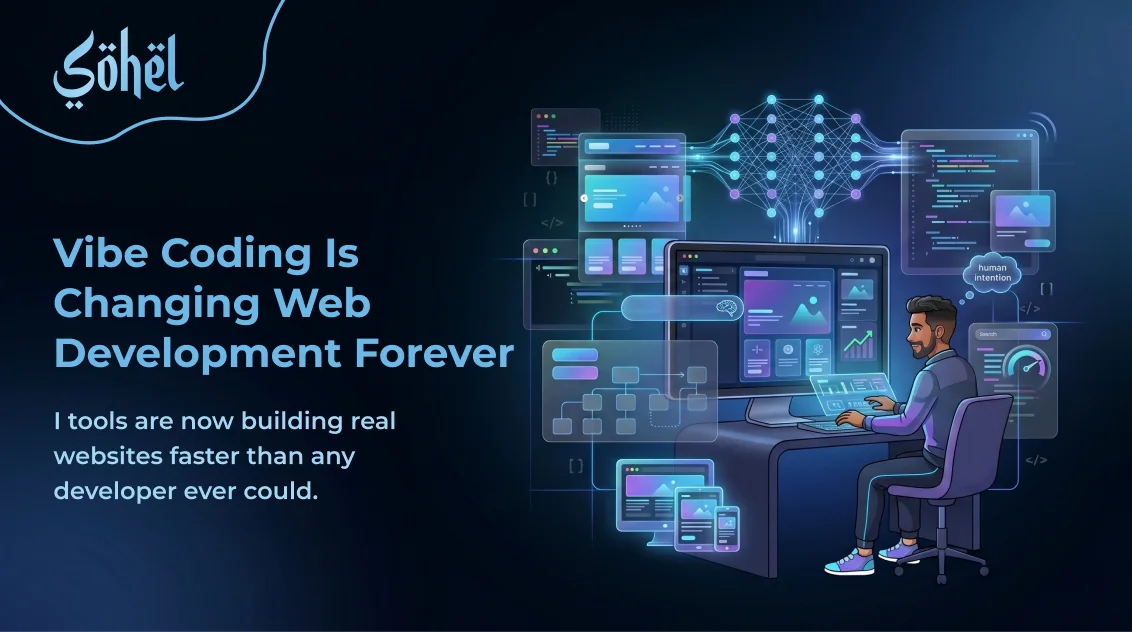
Something unprecedented is happening in web development right now. Developers are opening tools like Cursor, Bolt, v0, and Claude, describing what they want to build in plain English — and watching production-ready code appear in seconds. No Stack Overflow. No copy-pasting from documentation. No debugging syntax errors at midnight. They're calling it vibe coding, and it has become the most talked-about shift in the developer world since React changed front-end development a decade ago.
The term was coined by AI researcher Andrej Karpathy in early 2025 — and by 2026 it has moved from Twitter meme to mainstream industry reality. Vibe coding is not just about writing code faster. It represents a fundamental change in who can build for the web, what professional developers are actually paid to do, and what clients should expect when they hire a web professional. Whether you're a developer, a business owner, or somewhere in between — this shift is going to affect you directly. Here's everything you need to understand.
What Is Vibe Coding?
Vibe coding is the practice of building software by describing your intent in natural language and letting an AI model write, refactor, debug, and explain the code. Instead of writing const [isOpen, setIsOpen] = useState(false) from scratch, you tell the AI: "Add a toggle that shows and hides the mobile nav, animate it with a smooth slide-down transition" — and the code appears, complete, correct, and ready to use.
The name comes from the feeling of the workflow: you stay in a creative, high-level vibe — thinking about what to build, not how to write it. You're the architect directing a very fast, very knowledgeable contractor. The friction of syntax, documentation lookup, and boilerplate disappears. What remains is pure product thinking and design decision-making.
The Core Vibe Coding Tools in 2026
Cursor
AI-native code editor built on VS Code. Chat with your entire codebase, apply multi-file edits, and autocomplete at an entirely new level of context-awareness.
Bolt.new
Browser-based full-stack app builder. Describe a web app in plain English — Bolt generates a complete React or Next.js project, live in the browser, with npm packages installed.
v0 by Vercel
UI component generator that outputs production-ready React + Tailwind CSS components from a text description or screenshot. Paste into your Next.js project and ship.
Claude Code
Anthropic's agentic coding CLI. Reads your entire codebase, plans multi-step changes, writes and edits files autonomously, and runs tests — all from your terminal.
GitHub Copilot Workspace
Task-driven development in GitHub. Describe a feature or bug fix in natural language — Copilot plans, implements, and opens a PR automatically.
Lovable / Replit Agent
Full-product AI builders that go from idea to deployed web app. Describe your startup idea — get a working product with auth, database, and UI in under an hour.

Why Vibe Coding Exploded in 2026
Vibe coding existed in primitive form since GitHub Copilot launched in 2021 — but three things converged in 2025–2026 to make it mainstream. First, AI models crossed a quality threshold where generated code actually works the first time, most of the time. Second, context windows expanded dramatically — tools like Cursor and Claude Code can now read your entire 50,000-line codebase before suggesting a change, making suggestions genuinely aware of your project architecture. Third, browser-based builders like Bolt and Lovable removed the need for local development setup entirely, letting non-developers ship real applications.
The numbers tell the story. In early 2025, Andrej Karpathy posted that he had stopped writing most of his code by hand. By mid-2025, Y Combinator reported that over 25% of startups in their cohort had codebases that were 95%+ AI-generated. By 2026, every major IDE has an AI coding layer built in, and "how do I prompt Cursor to do X" has become a more common developer question than "how do I write X in JavaScript."
Vibe Coding vs Traditional Development: The Real Difference
Vibe coding is not simply autocomplete on steroids. It represents a shift in the unit of developer work. Traditional development operates at the line-of-code level: you think in syntax, debug character by character, and move through a codebase file by file. Vibe coding operates at the feature level: you think in outcomes, describe behaviors, and move through a codebase intent by intent. The AI handles the translation from intent to syntax.
| Aspect | Traditional Development | Vibe Coding (AI-Assisted) |
|---|---|---|
| Unit of work | Lines of code, functions | Features, behaviors, outcomes |
| Boilerplate time | Hours (setup, config, scaffolding) | Minutes (AI generates it instantly) |
| Documentation lookup | Constant (MDN, Stack Overflow) | Rare — AI knows the docs |
| Debugging approach | Manual — read error, trace cause, fix | Paste error into AI, get fix + explanation |
| Entry barrier | Years of learning syntax + patterns | Anyone can build simple projects immediately |
| Speed (simple feature) | 30 min – 2 hours | 2 – 10 minutes |
| Code quality control | Developer's full responsibility | Developer reviews and guides AI output |
What Vibe Coding Is Actually Good At
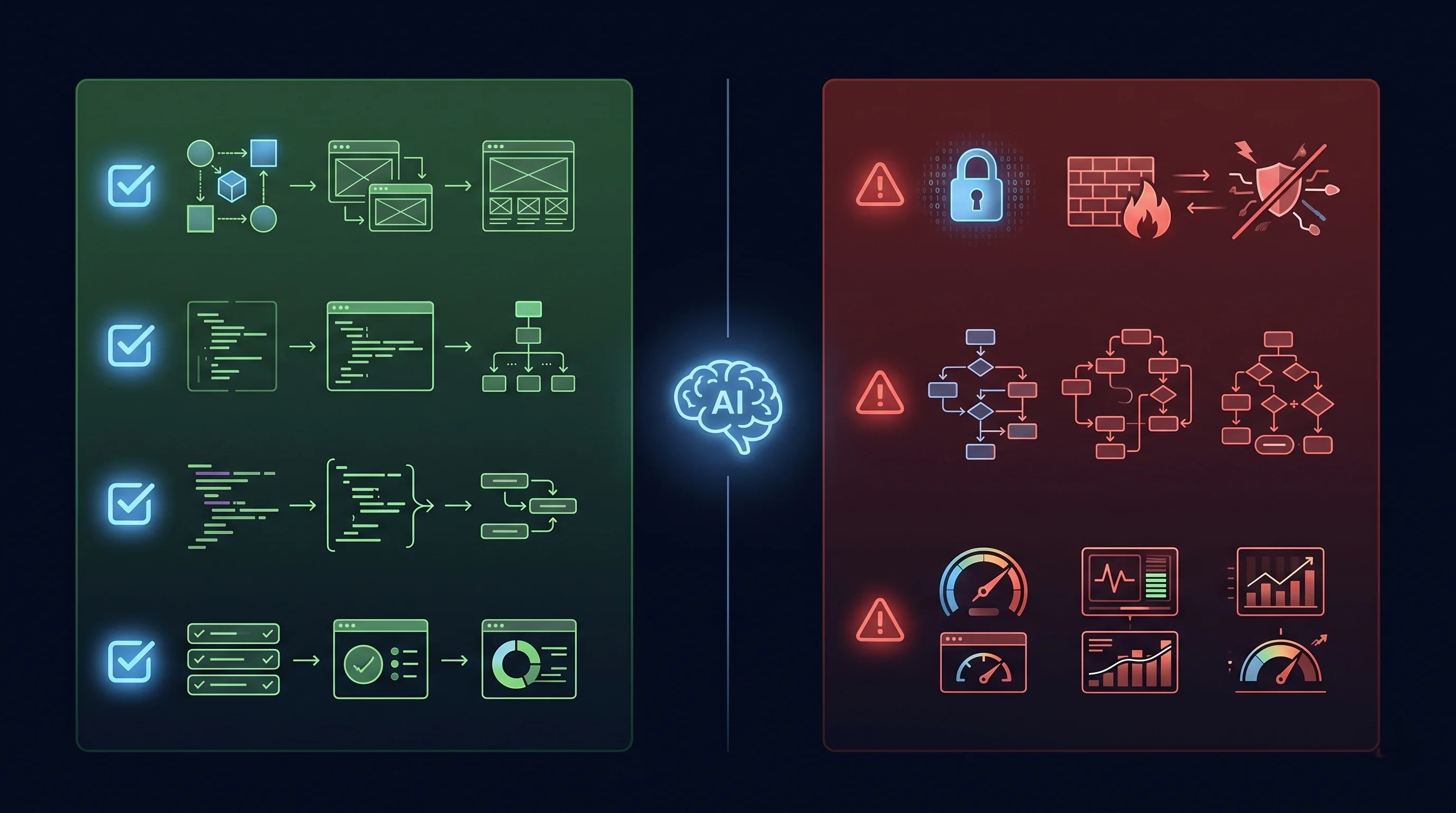
Not everything benefits equally from vibe coding. Understanding where AI-assisted development genuinely excels — and where it still struggles — is what separates developers who use it effectively from those who get burned by it.
Where Vibe Coding Excels
- Boilerplate and scaffolding — CRUD operations, auth setup, API routes, form validation, database schema — AI generates these perfectly every time.
- UI component generation — Describe a card, a modal, a pricing table, a dashboard widget — get pixel-ready React + Tailwind in seconds.
- Refactoring and cleanup — "Convert this class component to a functional component" or "Extract this logic into a custom hook" — done in one prompt.
- Debugging with error messages — Paste the console error and the relevant code block. AI identifies the root cause and fixes it, usually correctly on the first attempt.
- Writing tests — "Write Jest unit tests for this utility function covering edge cases" — AI generates comprehensive test suites that would take a developer an hour.
- Rapid prototyping — Go from a client brief to a functional clickable prototype in a single afternoon. Test ideas before committing to full development.
Where Vibe Coding Still Struggles
- Complex business logic — Multi-step workflows with edge cases, race conditions, and domain-specific rules still require a developer who deeply understands the problem.
- Security-critical code — Authentication systems, payment handling, data encryption — AI-generated code can have subtle vulnerabilities. Always needs expert review.
- Performance optimization — AI rarely considers database query efficiency, memory allocation, or render performance in its first pass. Optimization is still a human skill.
- Large codebase coherence — Across hundreds of files, AI can introduce inconsistencies in naming, patterns, and architecture without a developer guiding the overall vision.
Will Vibe Coding Replace Web Developers?
This is the question everyone is asking — and the honest answer is more nuanced than either the fear-mongers or the dismissers want to admit. Vibe coding is already replacing a specific type of developer work: the junior developer who was hired primarily to translate specifications into boilerplate code. If your value as a developer was mostly in knowing how to write a React useState hook or a WordPress custom post type from memory — that value has compressed significantly.
But development is not primarily about typing code. It's about understanding what a client or user actually needs, making architectural decisions that scale, ensuring security and performance, debugging problems that don't have a Stack Overflow answer, and communicating technical decisions to non-technical stakeholders. AI cannot do any of these things. A developer who understands vibe coding tools and uses them to multiply their output is not being replaced — they're being upgraded into a 10x developer who delivers client projects in a fraction of the time.
What Developers Need to Focus on in the Vibe Coding Era
- Prompt engineering for code — Writing precise, context-rich prompts that get the AI to the right output in one or two iterations, not ten. This is a genuine skill.
- Code review literacy — You still need to read and understand AI-generated code to catch bugs, security holes, and architectural problems before they ship.
- System design thinking — How does the whole application fit together? How does it scale? How does it fail gracefully? These decisions cannot be delegated to AI.
- Client and product skills — Understanding what a business actually needs, translating vague requirements into clear specifications, and managing project scope.
- Specialisation depth — Being genuinely expert in performance, accessibility, security, or a specific platform (WordPress, Next.js, Shopify) remains extremely valuable because AI is generalist.
What Vibe Coding Means for Business Owners and Clients
If you're a business owner who hires developers or agencies, vibe coding changes your market in two important ways. The first is positive: the cost and time required to build a website or web application has dropped significantly. Prototypes that used to take a week now take a day. Simple business websites that used to require a junior developer spending 30 hours now take an experienced developer 6 hours with AI assistance. Legitimate developers who use these tools well are delivering more for the same price.
The second change requires caution: the barrier to looking like a developer has dropped to nearly zero. Someone with no web development background can use Bolt or Lovable to build a site that looks functional in a demo — but has no SEO structure, no performance optimisation, no security hardening, and no maintainable codebase. In 2026, it is more important than ever to vet developers based on their understanding of why they made technical choices, not just whether the demo looks good.
| Question to Ask Your Developer | What the Answer Reveals |
|---|---|
| Why did you choose this tech stack? | Whether they understand your project's specific needs or just used defaults |
| How will this perform under traffic spikes? | Whether they've thought about scalability or just made it work for now |
| How is user data protected? | Whether security was considered during build or as an afterthought |
| Can you explain this section of code? | Whether they understand what they built or just ran a prompt and shipped it |
| What's the maintenance plan? | Whether they can support the project long-term, not just deliver a demo |
How to Start Vibe Coding: A Practical Beginner Path
Whether you're a developer wanting to adopt AI tools or a business owner wanting to prototype ideas before hiring a developer — here is a practical path to get started with vibe coding in 2026, ordered from zero technical knowledge to full developer workflow.
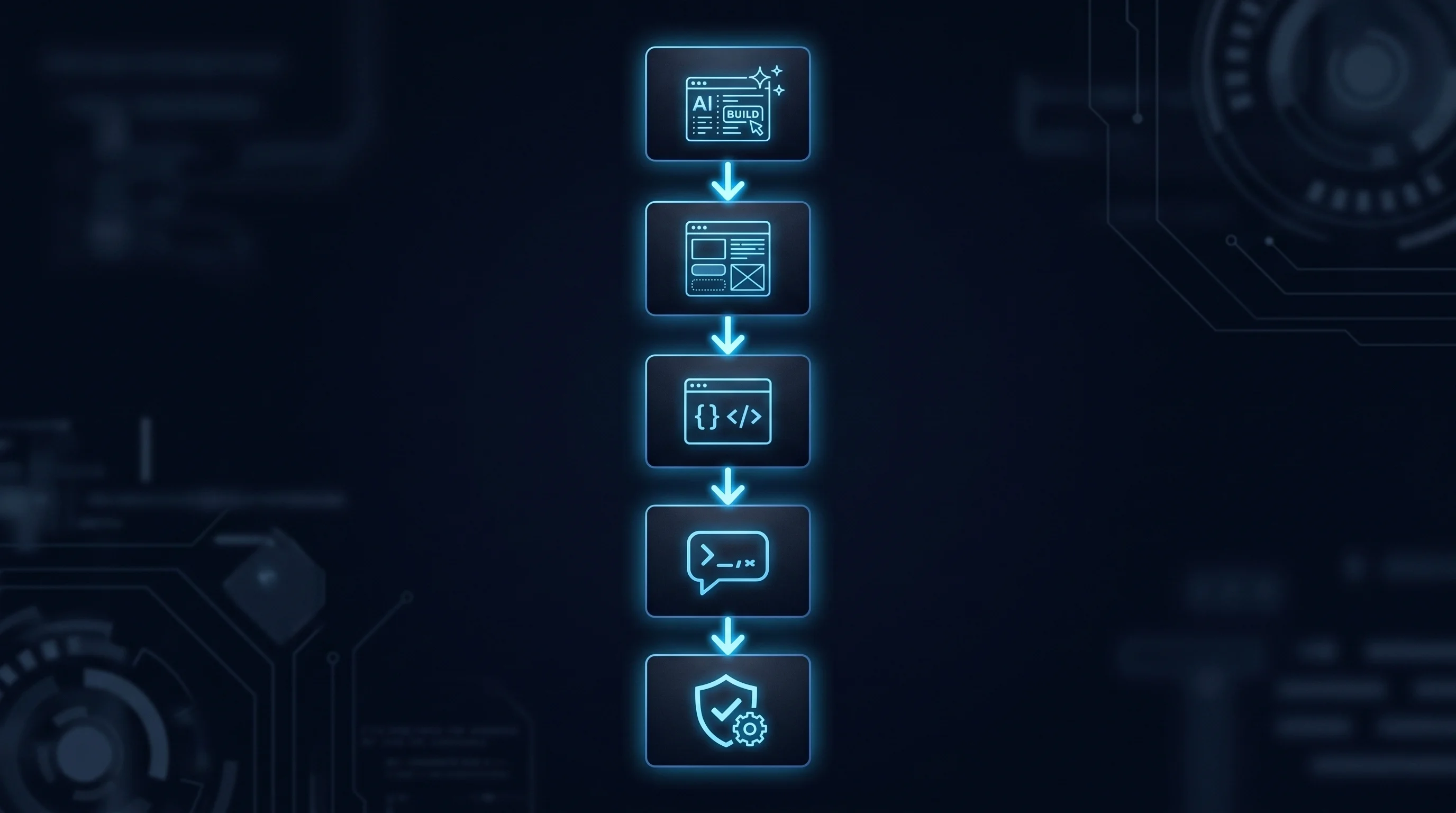
- Step 1 — Start with Bolt.new or Lovable — Zero setup. Describe your idea in the chat ("Build me a landing page for a yoga studio with a booking section") and get a live, editable result in under a minute.
- Step 2 — Use v0 for UI components — When you have a specific UI element you need (a pricing table, a testimonial slider), paste a screenshot or text description into v0 and get clean React + Tailwind code.
- Step 3 — Install Cursor (developers) — Replace VS Code with Cursor. Start using Cmd+K (inline edit) and the sidebar chat to get AI help within your actual codebase context.
- Step 4 — Learn to write good prompts — Be specific about tech stack, file structure, edge cases, and what you don't want. The quality of your output equals the quality of your input.
- Step 5 — Always review before shipping — Read every function the AI writes. Understand it. Test it. The moment you ship code you don't understand, you've created a liability.
The Verdict: Embrace Vibe Coding or Get Left Behind
Vibe coding is not a fad. It is the new default mode of professional web development in 2026 — the same way Git became the default for version control and npm became the default for package management. The developers and agencies who have already integrated AI tools into their workflow are delivering projects faster, taking on more clients, and building more complex products than they could in 2024. The ones who dismissed it as "just autocomplete" are now visibly slower and less competitive.
For business owners, vibe coding means faster timelines and lower costs for straightforward projects — but also a new responsibility to vet whether the AI-assisted code you're receiving is production quality. For developers, it means the ceiling on what a single person can build has risen dramatically. A solo developer with strong AI tool skills in 2026 can compete with a small team from 2022. That's not a threat — it's the biggest career upgrade the industry has ever seen, if you choose to take it.
Need a Website Built the Right Way in 2026?
I use the best AI tools alongside years of professional development experience to deliver fast, SEO-ready, high-converting websites — without cutting corners on quality, security, or performance.
Let's Build Together
Professional Web Designer and WordPress Developer from Gujarat, India. Helping brands grow online through clean, fast, and conversion-focused websites.
View Profile