Introduction
Let's be direct: if your website was built more than two years ago and hasn't been updated since, it is almost certainly not AI-ready. And in 2026, that gap between what your website is and what it needs to be is costing you — in lost rankings, lost leads, and lost revenue you'll never see because those visitors went to a competitor instead.
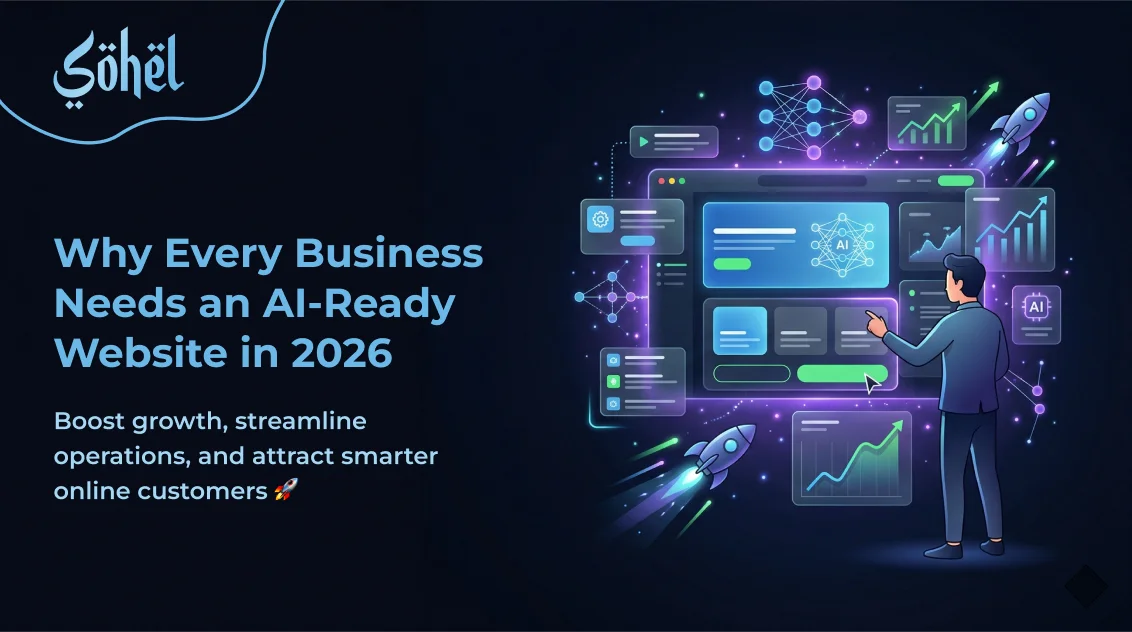
The term "AI-ready website" gets thrown around a lot, but most people don't actually know what it means in practical terms. It doesn't mean slapping a chatbot on your homepage and calling it done. It doesn't mean using AI to write your content. It means something far more structural — a website that is architecturally, technically, and strategically built to work with the intelligent systems that now govern how users find businesses, how search engines rank pages, and how visitors decide who to trust and buy from.
This guide breaks down exactly what an AI-ready website is, why it has become the new baseline for business success in 2026, and the concrete steps you can take to either build one from scratch or upgrade your existing site without starting over. The businesses that act on this now will have a compounding advantage over those that don't — one that gets harder to close with every month that passes.
The Shift That Changed Everything
To understand why AI-readiness matters so much in 2026, you need to understand the shift that happened in the web ecosystem over the past three years. It wasn't gradual — it was a step change.
Before 2023, the web was largely a static publishing medium. Businesses put information online. Search engines indexed it. Users searched for it. The relationship between a website and the systems around it was relatively simple and predictable. Good content plus good technical SEO plus decent page speed equalled good rankings. That formula still matters — but it's no longer sufficient on its own.
Since 2023, three seismic changes have reshaped the rules entirely. Google replaced its ranking systems with AI-first algorithms that evaluate context, user intent, and real-world utility rather than just keyword density. Generative AI tools like ChatGPT, Perplexity, and SearchGPT became major sources of traffic referrals — pulling answers directly from websites whose content is structured well enough for AI to read, understand, and cite. And user expectations crossed a threshold: people now expect websites to adapt to them, respond intelligently, and feel immediate — not make them hunt through pages of generic content for answers.
A website that was excellent in 2021 may now be structurally invisible to the AI layer of the modern web. It may be technically functional but algorithmically irrelevant. That's the challenge — and the opportunity — that AI-readiness addresses.
AI-First Search
Google's ranking systems now use AI to evaluate intent, context, and real-world utility — not just keywords and backlinks.
Generative AI Traffic
ChatGPT, Perplexity, and SearchGPT cite and link to well-structured websites — creating an entirely new organic traffic channel.
Raised User Expectations
Visitors now expect adaptive, personalized, instant-response web experiences — static brochure sites feel broken by comparison.
What Does "AI-Ready" Actually Mean?
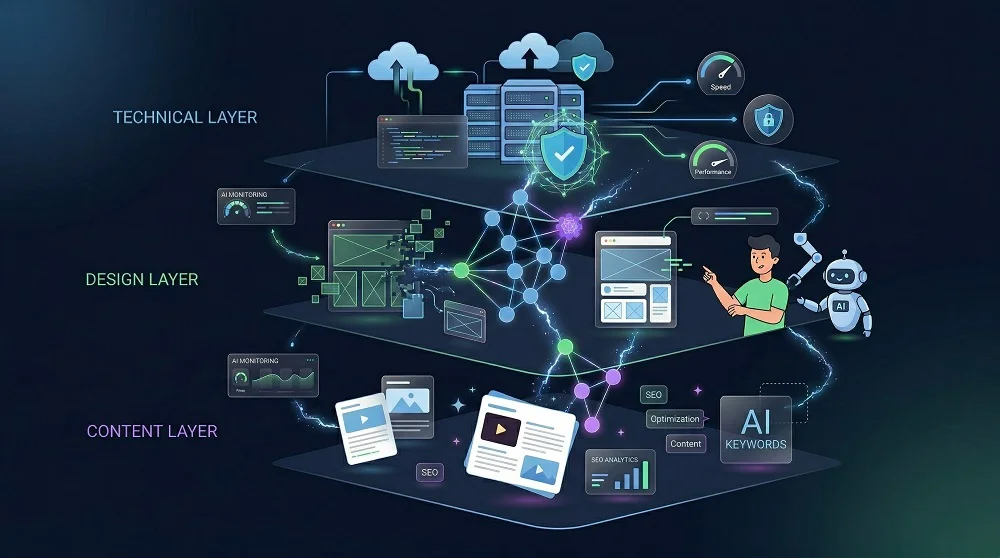
An AI-ready website is not defined by a single feature or a specific technology. It's defined by how well every layer of the website — technical infrastructure, design architecture, and content structure — enables artificial intelligence to do its job effectively. That AI includes Google's ranking systems, generative AI tools that cite web sources, personalization engines, and the intelligent tools your own team uses to operate and grow the business.
Think of it in three distinct but interconnected layers:
Technical Layer
Clean, well-structured code architecture. Fast load times that pass Core Web Vitals. Semantic HTML that search engines and AI crawlers can parse correctly. API-friendly infrastructure that allows AI tools, CRMs, analytics platforms, and automation systems to connect without friction. HTTPS, proper redirects, and a crawlable sitemap. These are the foundations that everything else depends on — and the foundations that most old websites are weakest on.
Design Layer
Layouts designed for dynamic, personalized content delivery. Interface patterns that AI can optimize based on real user behavior — heatmap data, scroll depth, click patterns. Modular, component-based design systems where blocks of content can be swapped, tested, and adapted without redesigning the entire page. Mobile-first design that doesn't just resize but genuinely prioritizes the mobile experience from the first pixel.
Content Layer
Well-structured content using correct semantic HTML5 elements — article, section, main, nav. Schema markup that tells AI systems exactly what your business does, where you're located, what you offer, and what your customers say about you. Natural language content that answers questions directly and authoritatively — the kind AI answer engines select to feature in their responses. A clear, logical content hierarchy that both users and algorithms can navigate without confusion.
When all three layers are aligned and working together, your website stops being a static destination and becomes an active participant in the intelligent digital ecosystem — one that earns organic traffic from AI systems, converts visitors through personalized experiences, and scales its capabilities as your business grows.
7 Ways an AI-Ready Website Drives Real Business Growth
It Ranks Higher in Google's AI-Powered Search Results
Google's ranking algorithm in 2026 is fundamentally different from the keyword-counting system of five years ago. It uses sophisticated AI models to evaluate every page it indexes against hundreds of signals simultaneously — assessing whether the content genuinely serves the user's intent, whether the technical implementation creates a positive user experience, and whether the overall website demonstrates the expertise, authoritativeness, and trustworthiness that Google's E-E-A-T framework demands.
An AI-ready website is built to score well on every one of these signals. Fast load times satisfy Core Web Vitals. Structured schema markup gives Google explicit, machine-readable information about your business. Semantically correct HTML helps the algorithm understand the hierarchy and purpose of every piece of content on the page. And high-quality, directly useful content signals genuine expertise rather than keyword stuffing.
The practical result: higher rankings for competitive terms, more visibility in Google's AI Overview summaries, and sustained organic traffic growth that doesn't evaporate the moment you pause your ad spend.
Real Impact
Websites that earn Featured Snippets and AI Overview placements receive up to 8x more organic clicks than standard organic results at the same position — and AI-ready content structure is the primary driver of those placements.
It Gets Cited by ChatGPT, Perplexity, and AI Answer Engines
A rapidly growing percentage of online searches in 2026 never reach a traditional search results page at all. Users ask a question in ChatGPT, Perplexity, or Google's own AI Overview — and receive a direct answer compiled from multiple websites, often with citations and links. This is a completely new traffic channel that didn't exist at scale three years ago, and it's growing faster than any other source of web traffic.
The websites that get cited in these AI-generated answers share a common set of characteristics: their content is structured clearly with proper headings, their answers to common questions are direct and factual rather than padded with fluff, their pages load quickly and are technically clean, and they have schema markup that helps AI systems understand the context and credibility of the information. These are the hallmarks of an AI-ready content architecture.
If your website isn't built this way, it is structurally invisible to these AI answer engines — regardless of how good your actual service or product is. The AI simply cannot read, understand, or cite content that isn't properly structured for it to consume.
It Delivers Personalized Experiences That Convert at Higher Rates
The conversion rate gap between personalized and non-personalized websites has grown dramatically in 2026. A website that shows the same homepage hero, the same headline, and the same CTA to every single visitor — regardless of where they came from, what device they're using, what city they're in, or whether they've visited before — is leaving substantial revenue on the table.
AI-powered personalization engines — integrated directly into modern website platforms through tools like Dynamic Yield, Insider, or even the conditional content features built into HubSpot and Webflow — allow websites to adapt their content dynamically. A visitor arriving from a Google search for "web designer for restaurants" sees different hero content than one arriving from a LinkedIn ad targeting e-commerce businesses. A returning visitor sees an acknowledgment of their previous visit. A mobile visitor sees a layout optimized for their device rather than a shrunken version of the desktop page.
Personalized websites consistently generate 15–20% higher conversion rates compared to static counterparts across every industry vertical that has been studied. For a business generating 100 leads per month from its website, a 15% improvement means 15 additional leads — every single month — at zero additional marketing cost.
It Qualifies and Converts Leads Automatically With AI Chat
The era of the static contact form as your primary lead capture mechanism is over. In 2026, businesses with AI-ready websites use conversational AI — properly configured, CRM-integrated chatbots — to engage visitors the moment they land, understand what they're looking for, qualify them as prospects, and either book them into a calendar or route them to the appropriate human team member.
The distinction that matters is between an isolated chatbot and a connected one. An isolated chatbot that answers basic FAQs but doesn't connect to your CRM, your availability calendar, or your service catalog is a novelty — it provides minimal business value and visitors quickly recognize its limitations. A connected chatbot that knows your services, can check appointment availability, pushes qualified leads directly into your pipeline, and escalates complex conversations to a human seamlessly is a 24/7 sales assistant that operates at zero marginal cost per interaction.
Platforms like Drift, Intercom, and Tidio with their AI capabilities are the most widely deployed solutions in 2026. Businesses that have properly configured and integrated these tools report handling 35–50% more initial customer inquiries without adding any headcount — and qualification rates that match or exceed human operators during business hours.
It Loads Faster — and Speed Directly Equals Revenue
Page speed has always mattered, but the relationship between speed and revenue in 2026 is more direct and more quantified than ever. Research consistently shows that a single 1-second improvement in page load time increases conversions by 7%. Sites that load in under 1 second convert 3x more than sites that load in 5 seconds. Google's Core Web Vitals — LCP, INP, and CLS — are hard-coded ranking factors that determine where you appear in search results relative to competitors.
An AI-ready website is built for performance at the infrastructure level: next-generation image formats (WebP and AVIF), server-side rendering that eliminates client-side JavaScript bottlenecks, CDN delivery for global audiences, lazy loading that prioritizes above-the-fold content, and minimal render-blocking resources. These aren't optional extras or nice-to-haves — they are the technical foundation that every other optimization sits on top of.
For businesses currently sitting at a PageSpeed score below 60, a serious performance optimization campaign — moving to managed hosting, implementing proper caching, converting images to WebP, and eliminating unused JavaScript — can realistically move that score to 90+ and produce an immediate, measurable improvement in both rankings and conversion rates.
It Connects to Your Entire Business Ecosystem Through APIs
One of the most underappreciated aspects of AI-readiness is API connectivity. An AI-ready website isn't just a standalone digital presence — it's a connected hub that integrates with the tools, platforms, and data systems your business depends on. Your CRM receives lead data the moment a form is submitted. Your inventory system connects to your product pages in real time. Your analytics platform tracks every meaningful interaction automatically. Your marketing automation triggers follow-up sequences based on specific page behaviors.
This level of connectivity is made possible by an API-first or headless architecture — a website built with clean, well-documented data interfaces rather than a monolithic theme that locks everything inside a single system. Platforms like Contentful, Sanity, and headless WordPress implementations allow your content and data to flow into websites, mobile apps, AI tools, and automation workflows through a single source of truth.
The practical impact for businesses is enormous. It means your marketing team can update content without a developer. Your sales team sees website lead data directly in their CRM. Your customer success team can trigger personalized follow-ups based on the specific pages a prospect visited. The website becomes an active participant in your revenue operations — not an isolated digital asset.
It Uses AI Analytics to Continuously Improve Itself
Perhaps the most powerful growth driver of an AI-ready website is its ability to learn from its own performance and improve continuously — without requiring a developer to diagnose every issue or interpret every data point manually. AI-powered analytics tools that are integrated into an AI-ready website don't just collect data — they surface insights, identify patterns, flag underperforming pages, and suggest specific improvements based on real user behavior.
Tools like Microsoft Clarity provide session recordings and AI-generated heatmaps that show exactly where users lose interest or get confused on any given page. Google's AI-powered Search Console insights identify which content is gaining or losing visibility in search. A/B testing platforms with AI-driven traffic allocation — like Optimizely or VWO — automatically shift traffic to better-performing page variants as soon as statistical significance is reached.
The cumulative effect of this continuous optimization loop is a website that gets measurably better at converting visitors every single month — without requiring expensive agency engagements or constant developer intervention. The website becomes a self-improving asset rather than a depreciating one.
The Real-World Gap: What AI-Readiness Looks Like in Practice
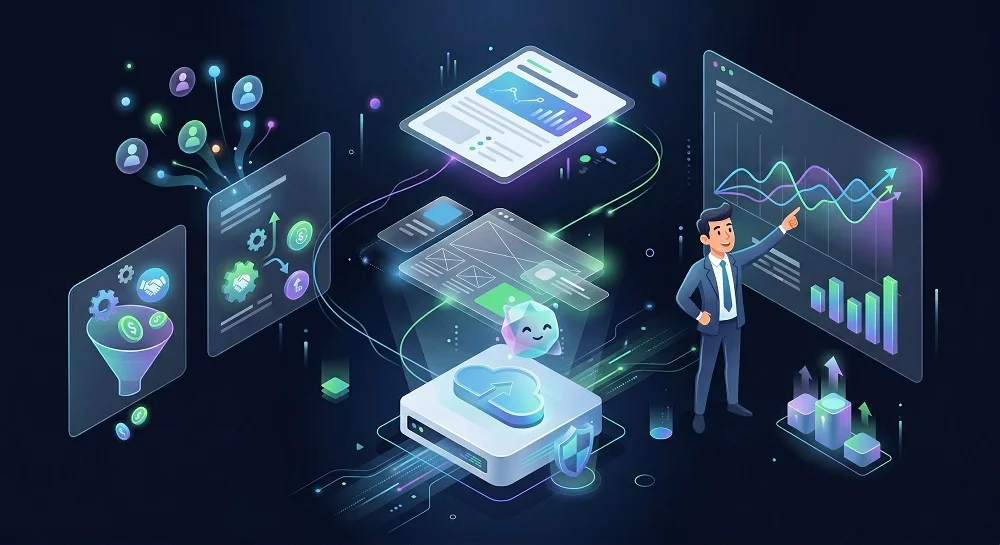
Abstract concepts become real when you compare two concrete examples. Consider two competing businesses in the same industry and the same market, both running digital marketing campaigns and both investing in their online presence. The difference isn't their budget — it's the quality and intelligence of the website that budget is pointing to.
Business A — Standard Website
- Loads in 4.8 seconds on mobile — fails Core Web Vitals
- No schema markup — invisible to AI answer engines
- Static homepage shows identical content to every visitor
- Contact form only — no lead qualification or chat
- No CRM integration — leads managed in email inbox
- Analytics shows traffic but no behavioral insights
Business B — AI-Ready Website ✦
- Loads in 1.1 seconds — passes all Core Web Vitals
- Full schema markup — cited in AI Overview and Perplexity
- Hero section adapts to visitor location, source, and history
- AI chatbot qualifies leads and books consultations 24/7
- Full CRM sync — every lead scored, tracked, and followed up
- Clarity heatmaps and AI insights drive weekly improvements
Six Months Later — Business B Results:
3x
More qualified leads per month from the same traffic volume
40%
Less time spent on manual customer follow-up and qualification
Top 3
Google rankings for primary service keywords — including AI Overview placement
22%
Higher average conversion rate across all landing pages within 90 days
Is Your Website AI-Ready? Here's How to Find Out
Before investing in upgrades, it's worth diagnosing exactly where your current website stands. Most businesses are surprised by how many gaps exist — not because their website is bad, but because it was built to a standard that was current in 2020 or 2021, when AI-readiness wasn't a meaningful consideration.
Run through this diagnostic honestly:
Performance Test
Run your site through Google PageSpeed Insights. A score below 70 on mobile is a clear signal of significant performance debt. Core Web Vitals failures are immediate ranking liabilities.
Schema Markup Check
Use Google's Rich Results Test on your homepage and key service pages. If no schema is detected, your site is invisible to AI answer engines and ineligible for rich snippet features in search.
Mobile Experience Audit
Open your website on your actual phone. Does it feel like it was designed for mobile — or like a desktop site that was forced to fit a smaller screen? Is text readable without zooming? Are buttons tappable without precise aim?
Lead Capture Assessment
Is your primary lead capture mechanism a static contact form? Does your website have any mechanism for engaging visitors who aren't ready to fill out a form yet? Does your lead data automatically reach the right person or system?
Analytics Depth Check
Do you know which pages on your site convert best? Which ones have the highest exit rates? Where visitors are dropping off in your conversion funnel? If these answers aren't immediately available, your analytics setup needs upgrading.
How to Make Your Website AI-Ready: The Upgrade Roadmap
The good news: you almost certainly don't need to rebuild your entire website from scratch. In the majority of cases, a targeted, phased upgrade delivers AI-readiness faster and at far lower cost than a complete rebuild. The key is sequencing the improvements correctly — starting with the changes that deliver the highest immediate impact and working toward the more advanced capabilities from a solid foundation.
Phase 1 — Foundation (Month 1–2)
- Performance audit and Core Web Vitals optimization
- Migrate to managed hosting if currently on shared
- Implement schema markup on all key pages
- Upgrade to AI-powered analytics (Clarity + Search Console)
- Fix mobile experience and responsive breakpoints
Phase 2 — Intelligence (Month 3–4)
- Integrate and configure AI chatbot with CRM connection
- Restructure content for semantic HTML and AI readability
- Build dedicated FAQ sections targeting AI answer engines
- Set up lead tracking and CRM automation workflows
- Begin A/B testing key landing page elements
Phase 3 — Personalization (Month 5–6)
- Implement conditional content blocks for different audiences
- Set up location-aware content for local service areas
- Configure dynamic hero sections for traffic source segments
- Deploy returning visitor experience optimization
- Launch continuous heatmap-driven CRO programme
Phase 4 — Scale (Month 6+)
- Evaluate headless CMS migration for multi-channel delivery
- Expand API integrations across full marketing and sales stack
- Build programmatic SEO content pages at scale
- Deploy advanced analytics attribution modelling
- Quarterly AI-readiness audits and evolution roadmap reviews
The Cost of Waiting
One of the most common objections businesses raise when they learn what AI-readiness requires is that it sounds expensive or time-consuming. It is an investment, without question — but the more important calculation is the cost of not making it.
Every month your website fails Core Web Vitals is a month of suppressed search rankings — meaning visitors who could be finding your business are being sent to a competitor who passes. Every month without schema markup is a month of invisibility in AI Overview and generative AI citations — a traffic channel that's growing faster than traditional search. Every month with a static contact form instead of an AI-powered lead qualification system is a month of manually handling enquiries that a connected chatbot would process faster and at zero marginal cost.
These costs compound. Competitors who adopt AI-readiness earlier build SEO authority that takes months to match. They build AI citation history with platforms like Perplexity that reinforces their visibility every time a new user asks a relevant question. They build conversion data and A/B testing history that informs smarter and smarter decisions over time.
The Numbers That Make the Case:
84%
of developers now use AI tools in workflows — AI-first development is the professional standard
53%
of mobile users abandon sites that take longer than 3 seconds — directly losing you leads
75%
of consumers judge business credibility from website design alone before reading any content
7%
conversion drop for every 1-second delay in page load time — pure revenue lost silently
Conclusion
The shift to AI-ready websites is not a trend that's coming — it has already happened. The businesses that are winning online in 2026 aren't necessarily the ones with the biggest budgets or the most recognizable brands. They're the ones that recognized this shift early, built websites that work with the intelligent systems powering modern search and user behavior, and created digital presences that improve themselves continuously through data and AI-assisted optimization.
An AI-ready website isn't a silver bullet. It doesn't replace great products, strong teams, or genuine customer relationships. But it creates the digital conditions for all of those strengths to be found, trusted, and chosen by the right customers at the right time — which is ultimately what every business needs its website to do.
The question isn't whether your business needs an AI-ready website. The question is how much longer you can afford to operate without one — while your competitors who already have one are compounding their advantage every single day.
An AI-ready website doesn't just keep up with the future. It positions your business to shape it.
Ready to upgrade?
Let's build your AI-ready website
From performance optimization to chatbot integration — get a website that works as hard as you do, 24/7.
Start a Project →
Professional Web Designer and WordPress Developer from Gujarat, India. Helping brands grow online through clean, fast, and conversion-focused websites.
View Profile