Here's a question that should make every blogger, marketer, and business owner a little uncomfortable right now:
When was the last time you actually scrolled past the first result on Google — or better yet, didn't use Google at all?
Think about it. Increasingly, people are skipping the search bar entirely. They're opening ChatGPT, typing a question, and getting a full answer in seconds. No links. No scrolling. No ads. Just the answer.
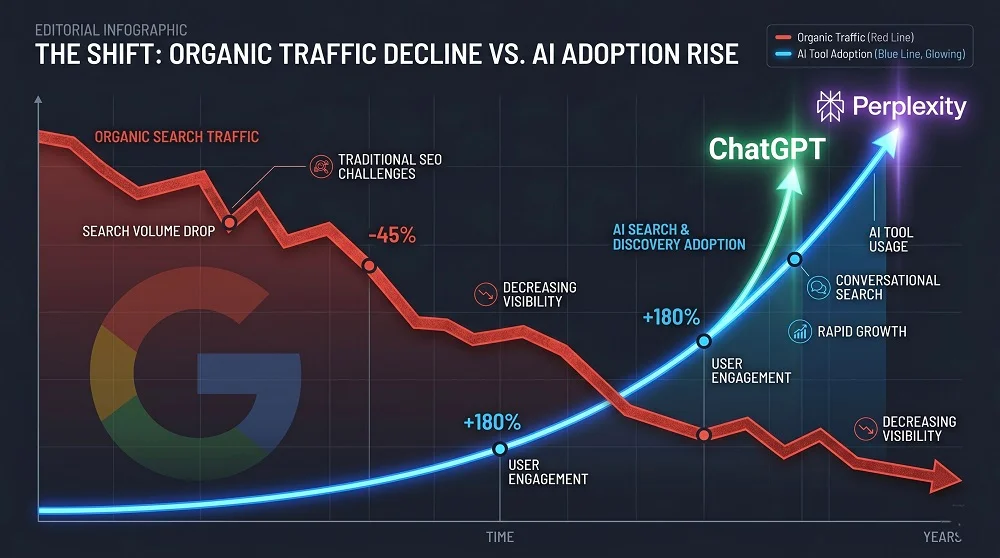
That behavioral shift — which seemed like a niche thing two years ago — has become mainstream in 2026. And it's quietly dismantling the SEO playbook that the entire digital marketing industry has been running on for the past two decades.
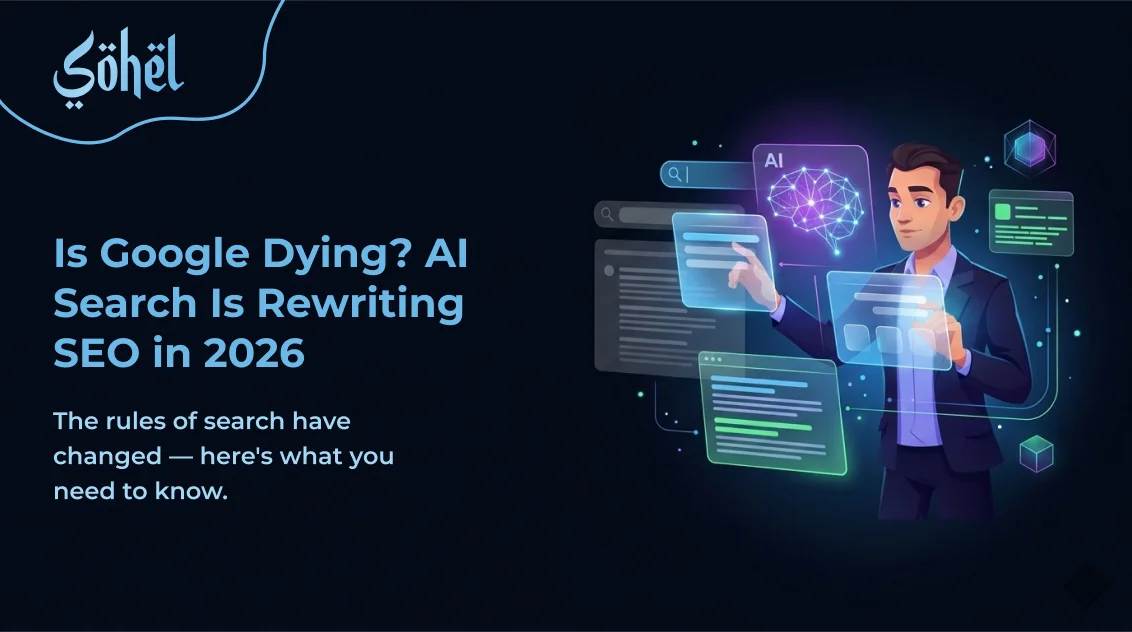
Is Google dying? Probably not in the dramatic way that headline implies. But is it losing its grip on how people find information? Absolutely yes. And if your traffic strategy still depends entirely on Google rankings, you're already playing a game that's changing beneath your feet.
Let's talk about what's actually happening — and more importantly, what to do about it.
The Shift Nobody Wants to Talk About
For years, the internet ran on a simple loop: person has a question → person Googles it → clicks a blue link → lands on a website. That loop built entire industries. Blogging empires. Content agencies. SEO consultancies worth millions.
That loop is breaking.
In 2023, ChatGPT crossed 100 million users faster than any product in history. By 2025, Perplexity AI was fielding over 100 million queries per month. Claude became a go-to research assistant for professionals who used to spend hours on Google. Even Microsoft's Bing, long the butt of every tech joke, gained real traction after integrating AI-generated answers at the top of results.
Meanwhile, Google's own data — the data they don't advertise — showed something uncomfortable: search click-through rates were declining. Users were getting what they needed from AI Overviews (Google's own AI answer feature) without ever visiting a single website.
📊 The Numbers That Tell the Story
- →Over 58% of Google searches in 2024 ended without a single click — known as zero-click searches
- →Organic search traffic dropped by an average of 20–30% for informational content sites after AI Overviews rolled out
- →AI search tools are now used daily by over 40% of knowledge workers for research that previously meant Googling
The shift is real. It's accelerating. And the people who acknowledge it early are the ones who'll adapt in time.
Why Traditional SEO Is Breaking Down
To understand why everything is changing, you first need to understand what made traditional SEO work — and why those same mechanics are now working against content creators.
The Zero-Click Problem
Zero-click searches aren't new. They've been growing since Google introduced featured snippets years ago — those answer boxes at the top of results that give you the information without making you click anywhere.
But AI Overviews turbocharged this problem. Now instead of a single featured snippet, Google generates a multi-paragraph summary pulling from dozens of sources — and presents it right at the top of the page. The user reads the answer. Gets what they need. Leaves.
Your article might be one of the sources Google used to build that summary. You might have spent 10 hours researching and writing it. And you'll never see a single visitor from it.
The Ranking Game Is Getting Harder to Win
It used to be that with enough backlinks, good on-page SEO, and solid content, you could rank. That's still partially true — but the playing field has shifted dramatically.
Google's own AI content policies created a paradox: they say they reward helpful, human content — but the algorithm increasingly favors big established domains with massive authority. A solo blogger writing genuinely excellent content often can't compete with a Forbes article that's mediocre but has 10,000 backlinks.
And on top of that, AI Overviews now sit above even the #1 organic result. Ranking first on Google used to mean being at the top. Now it means being below the AI answer that everyone reads first.
The Real Killer: AI Summaries Replacing Websites
This is the one that keeps content creators up at night. When someone asks Perplexity "what's the best CRM for small business," they don't get 10 blue links anymore. They get a structured, cited answer that compares options, gives a recommendation, and links to three sources — maybe.
The remaining 47 websites that spent years optimizing for that keyword? They get nothing.
What Is AI Search — And How Is It Actually Different?
If you've only used Google your whole life, AI search feels almost magic at first. But once you understand how it works, you'll realize why it's so fundamentally different — and why it changes the rules for content entirely.
Traditional Search: The Index Model
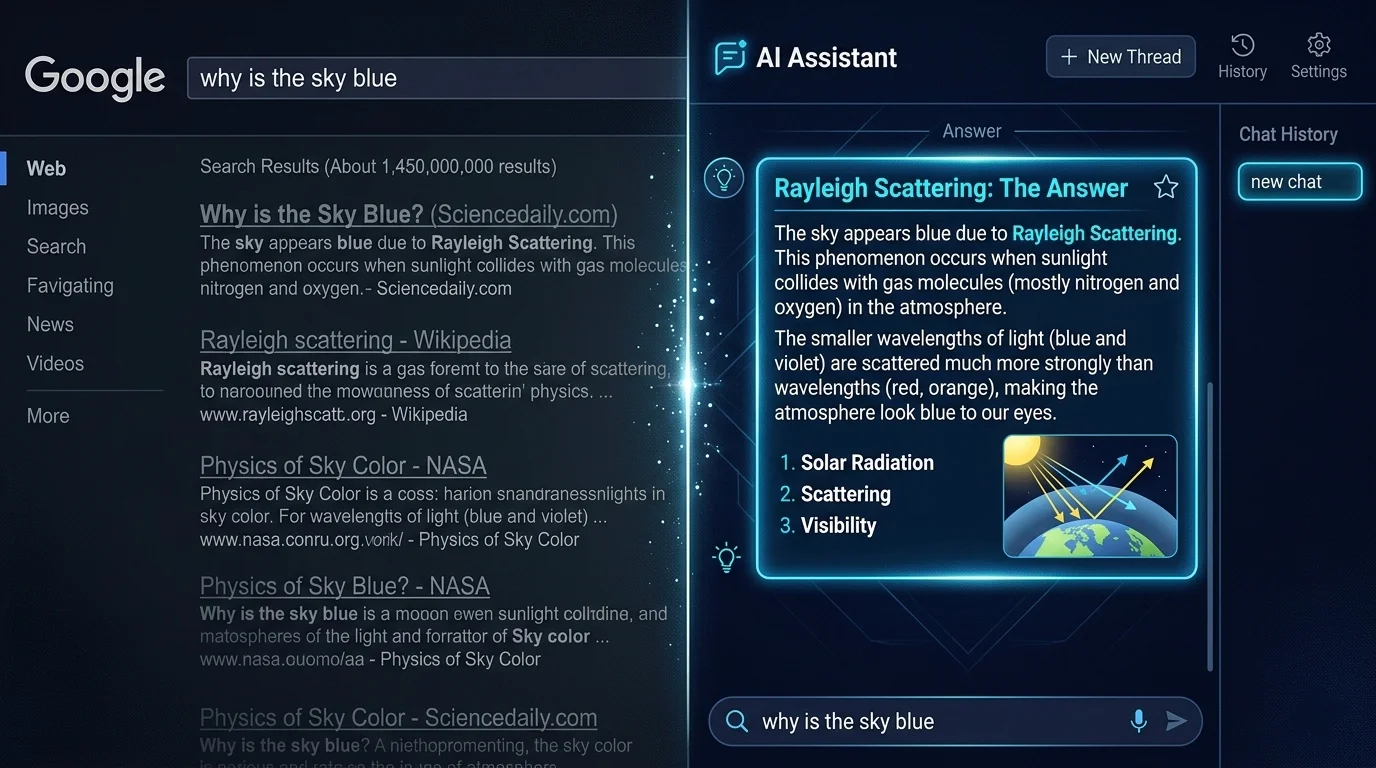
Google crawls billions of web pages, indexes them, and when you search, it surfaces the pages it thinks best match your query. It's essentially a very sophisticated filing system. You ask a question, Google points you to documents that might contain the answer. You go find the answer yourself.
AI Search: The Answer Model
AI search tools like Perplexity AI, ChatGPT with browsing, and Google's AI Overviews work differently. They don't just point you at documents — they read and synthesize information from multiple sources and generate a direct answer in natural language.
It's the difference between a librarian saying "the answer is probably in aisle 7" versus one who reads all the books in aisle 7, synthesizes the key points, and tells you the answer directly.
| Factor | Traditional Google Search | AI Search (Perplexity / ChatGPT) |
|---|---|---|
| Output | List of links | Direct synthesized answer |
| User Action | Click, read, return | Read answer, done |
| Sources | Individual ranked pages | Multiple sources synthesized |
| Traffic to sites | Depends on rank | Minimal, citation-based only |
| Follow-up | New search | Conversational follow-up |
This conversational nature is the key differentiator. AI search isn't a one-shot transaction — it's a dialogue. And that changes not just how people search, but what kind of content gets surfaced and trusted.
The Real Impact on Bloggers & Businesses
Let's be real for a moment. The impact isn't abstract — it's showing up directly in analytics dashboards across the internet.
Traffic Is Dropping — Especially for Informational Content
If you've built a content business on "how to" articles, listicles, and informational guides — the kind of content that ranks well for educational queries — you've probably already felt this. These are exactly the content types that AI Overviews and AI search tools answer best, which means they're also the ones bleeding traffic most aggressively.
A travel blogger writing "best things to do in Kyoto" doesn't just compete with 200 other travel bloggers anymore. They compete with an AI-generated itinerary that Perplexity serves up in 3 seconds, personalized to the user's travel dates, budget, and interests.
Content Strategy Is Changing Fast
The "publish 30 keyword-optimized articles a month" strategy that content farms ran for years? That's dead. AI can generate that content infinitely — and Google knows it, which is why they're heavily devaluing it algorithmically.
What's gaining value instead: original research, lived experience, unique perspectives, and expertise that AI literally cannot replicate because it didn't happen yet when the model was trained.
Authority and Brand Are Now Everything
Here's the silver lining — and it's a significant one. When AI search tools do cite sources, they overwhelmingly cite authoritative, trusted brands. Not random SEO-optimized articles from sites nobody has heard of.
Which means: building genuine brand authority — being a recognizable name in your niche, having real expertise and a real audience — is now more valuable than any technical SEO trick you could deploy. The people who spent the last few years building trust with their audience instead of just chasing rankings? They're the ones winning right now.
The New SEO Strategy for 2026 — What Actually Works Now
Okay — so traditional SEO is weakening, AI search is rising, traffic is shifting. What do you actually do about it? Here's the framework that's working right now.
1. Write for AI, Not Just Google
This sounds counterintuitive until you understand what it means. AI search tools are looking for content that is clear, authoritative, well-structured, and directly answers specific questions. Ironically, this is exactly what good content has always been — but the SEO industry spent years optimizing for keyword density and backlinks instead.
Writing for AI means: answer the question directly in your first paragraph. Use clear headings. Define terms. Cite real data. State your perspective explicitly. Don't bury the lede under three paragraphs of generic intro that was only there for the word count.
2. Build Topical Authority — Go Deep, Not Wide
The era of the generalist content site is effectively over. You can't write about productivity one week, cryptocurrency the next, and travel the week after and expect any of it to rank meaningfully. AI search tools — and Google's own algorithm — heavily favor sites that demonstrate deep expertise on a specific topic.
Topical authority means owning a subject area comprehensively. If you run a web design blog, don't just write about design trends — write about design tools, design psychology, client management for designers, design pricing, portfolio advice. Cover the full topic ecosystem until you're the most comprehensive resource in that niche.
When AI tools are deciding which sources to cite for a web design question, the site that covers the topic most completely wins every time.
3. Personal Branding Is Your New Moat
AI can write generic content. It cannot be you. Your experiences, your opinions, your case studies, your voice — these are things AI search cannot synthesize because they don't exist anywhere yet when the model was trained.
In 2026, the most durable SEO strategy is one where people search specifically for you — your name, your brand, your methodology. When someone Googles "how Sohel builds websites" instead of just "how to build a website," you've won that search in a way no algorithm change can take from you.
Invest in LinkedIn, in YouTube, in being visible and vocal in your industry. Personal brand isn't a vanity project — it's infrastructure.
4. Multi-Platform Presence — Don't Live and Die by Google
Any business that built its entire audience on a single channel learned a hard lesson the last time an algorithm changed overnight. That lesson is even more critical now.
Build an email list. Grow a YouTube channel. Be active on LinkedIn or Twitter. Create a community. The goal is to own your audience directly — so that when Google's algorithm shifts, when AI Overviews swallow your traffic, when a competitor outranks you, you still have a direct line to the people who care about your work.
Step-by-Step: How to Optimize Content for AI Search in 2026
Here's a practical, actionable guide you can apply to every piece of content you create right now.
Answer First, Explain Second
Lead every article with a direct, clear answer to the question your headline promises. AI tools extract the core answer from your first 100–150 words. If it's buried in paragraph 6, you won't get cited. Give the answer upfront — then spend the rest of the article explaining the nuance.
Use Question-Based Headings
Structure your subheadings as questions your reader is actually asking. "What is topical authority?" "How does AI search work?" "Why is zero-click search growing?" This mirrors how people phrase queries to AI tools — and makes your content far more likely to be pulled into AI-generated answers.
Cite Real Data and Original Sources
AI citation algorithms heavily weight content that references credible, verifiable data. Link to studies, reports, and original research. Better yet, publish your own data — surveys, case studies, client results. Original data is the highest-value content type in 2026 because AI tools want to cite the source, not the aggregator.
Add Schema Markup — Especially FAQ Schema
Structured data helps AI crawlers understand what your content is about and where the most important information lives. FAQ schema in particular signals to AI systems that your page contains question-and-answer formatted content — which is exactly the format AI search loves to pull from.
Build E-E-A-T Signals Into Every Page
Google's E-E-A-T framework — Experience, Expertise, Authoritativeness, Trustworthiness — has become even more critical as AI tries to determine which sources to trust. This means: real author bios with credentials, links to social profiles and professional portfolios, transparent about who runs the site, and content that reflects actual lived experience with the topic.
Use AI Tools to Research, Not to Replace Your Voice
Tools like ChatGPT and Claude are incredibly useful for researching a topic, finding angles, and structuring an outline. But the writing itself — especially your opinions, examples, and unique insights — needs to be yours. AI-written content that tries to compete with AI search will always lose. Human perspective is your only irreplaceable edge.
Future Predictions: What Happens After 2026?
Predicting the future of search is genuinely difficult right now because the pace of change is faster than at any point in the internet's history. But here's where the trajectory is pointing.
Will Google Survive?
Yes — but not in the same form. Google is not going away. It's a company with $300 billion in annual revenue, the largest data advantage of any company on earth, and a 20-year head start in search infrastructure. It's not disappearing tomorrow.
But Google as the default way humans find information? That monopoly is genuinely under threat for the first time. What we're likely to see is Google transforming from a search engine into an AI assistant — which, ironically, is exactly what they're trying to do with Gemini and AI Overviews.
The question is whether they can make that transition fast enough — and whether the revenue model that depends on ads driving clicks survives a world where users never need to click anywhere.
The Rise of AI Agents — Search Without Searching
Here's the really mind-bending part of where this is going. AI agents — tools like OpenAI's Operator, Anthropic's Claude with computer use, and Google's Project Mariner — can browse the web, fill out forms, make purchases, and complete tasks autonomously.
In that world, the "search" doesn't happen visibly at all. You tell your AI agent "book me a flight to Tokyo under ₹60,000 with one stopover" and it goes out, searches, compares, and books — without you ever seeing a search results page.
For SEO, this means the website that gets chosen isn't necessarily the one that ranks #1 on Google — it's the one the AI agent determines is the most trustworthy, most clearly structured, and best suited to the task. Technical trust signals, structured data, and genuine authority will matter more than ever.
The Long-Term Bet: Community and Original Thought
In a world flooded with AI-generated answers, the content that survives will be the content that comes from communities, real experiences, and genuine human perspectives that AI can't replicate. Reddit is already seeing massive traffic growth because people specifically want human answers, not polished AI responses. Niche communities, newsletters, podcasts, and personal brands built on real expertise — these are the long-term winners of the AI search era.

The Takeaway — Adapt Now, Not Later
Here's the honest truth: the people who are panicking about AI search are the ones who built their entire strategy on gaming an algorithm. The people who are calm? They're the ones who spent the last few years building real authority, real audiences, and real trust in their niche.
AI search isn't the end of SEO — it's the end of lazy SEO. The keyword-stuffed, thin-content, backlink-scheme approach that never should have worked as long as it did is finally getting what it deserves.
What's emerging is actually a better internet for everyone — one where genuine expertise gets rewarded, where original thought has value, and where the best content wins not because it gamed an algorithm but because it actually deserved to win.
The question you need to ask yourself right now is: if Google disappeared tomorrow and AI tools took over completely, would your content still get found? Would people still seek out your brand specifically? If the answer is yes — you're going to be fine. If it's no — you now know exactly what to work on.
Ready to upgrade?
Let's build your AI-ready website
From performance optimization to chatbot integration — get a website that works as hard as you do, 24/7.
Start a Project →
Professional Web Designer and WordPress Developer from Gujarat, India. Helping brands grow online through clean, fast, and conversion-focused websites.
View Profile